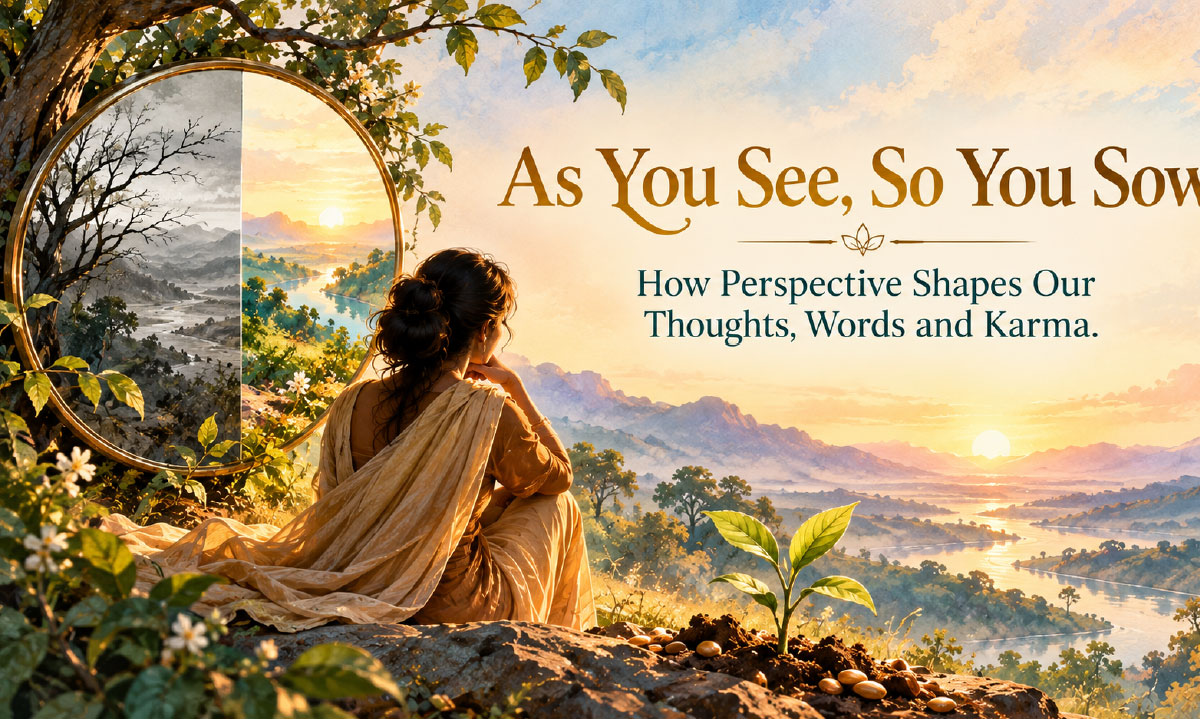
How Perspective Shapes Our Thoughts, Words and Karma
For more than two decades, I have sat with people – hundreds of them, perhaps well over a thousand – as they worked through what life had placed in front of them.
Different lives. Different circumstances. Different kinds of pain.
And yet, again and again, we arrive at the same quiet understanding:
Much of our suffering is shaped not only by what happens to us, but by how we look at it.
We carry fixed pictures of how things should go — how a person should behave, how a relationship should show up for us, how our effort should pay off.
I have put in this much work, so it should amount to that.
Some of these pictures are our own. Many are handed to us by family and society, with all their shoulds and shouldn’ts.
And when life doesn’t match the picture, we suffer.
It Begins With How We See
One of the most useful things I know for loosening that grip is perspective.
Early in my career, I learned to look at any situation from three positions: the worm’s-eye view, the eye-level view and the bird’s-eye view.
Moving between them, something softens.
This is how I am seeing it right now.
This is how the other person may be seeing it.
And this is what might actually be happening.
Nothing is set in stone.
Perspective is never entirely neutral, either. It is coloured by our mood, our emotions and even our physical state.
One day you are deeply in love, certain it will last this life and the next seven.
The next day, a little out of sorts, that same beloved becomes someone whose chewing you cannot bear to watch.
I am sure every one of you has been there.
From Seeing to Sowing
Here is why this matters.
We rarely control what arrives in our lives.
But the way we see what arrives shapes how we respond to it – and how we respond is where our present action, and therefore our present karma, is being created.
So I decided to go deeper: into the texts I have studied, especially the Bhagavad Gita – which I first read as a student, through many commentaries, not as an expert – and into what I have witnessed in my work.
Let me begin with what karma is – and what it is not.
Most of us grew up hearing karma used as a threat or a promise:
Do bad, suffer later. Do good, get rewarded.
The Indian philosophical traditions offer something more nuanced. Different Hindu traditions understand karma in somewhat different ways, so there is no single, universally agreed account of exactly how karma operates.